
Give each stage of product planning a clear job.
The five-skill workflow separates discovery, map creation, gap finding, story refinement, and navigation. Each stage has a different input and output, so an agent does not have to treat an uncertain idea and an approved backlog as the same task.
- Discovery
- Map creation
- Gap review
- Refinement
- Navigation
Choose the role for the current task. Navigation can help throughout the process; these are not mandatory steps on every run.
A procedure around the model and its tools
A skill is a reusable set of instructions for a task. The five roles described here are part of the published StoriesOnBoard workflow: Product Discovery, Story Map Creator, Gap Finder, Story Refiner, and Navigator. They run in an agent environment; they are not five extra buttons in the StoriesOnBoard toolbar.
MCP supplies access to the live board. The skill explains how to approach the work. Your brief supplies the actual product problem. Keep those three pieces distinct when setting up or debugging the workflow. A detailed instruction cannot compensate for missing access, and a working connection cannot decide which product to build.
Read the documentation: Five skills, one backlog: the workflow explained
The five roles and their handoffs
Choose a role based on what is uncertain now. Discovery addresses an unclear problem. Creation organizes an agreed direction. A gap review challenges the resulting coverage. Refinement develops selected stories. Navigation helps identify the current stage and the next unresolved decision.
The table is a practical way to plan a handoff. Treat its output checks as review questions for your team, not as a claim that the model can certify completion.
| Role | Bring | Review before moving on |
|---|---|---|
| Product Discovery | An idea, users, evidence, constraints | A clear problem and explicit assumptions. |
| Story Map Creator | An agreed brief and intended map | A coherent backbone and proposed stories. |
| Gap Finder | A map, persona, and release boundary | Prioritized gaps with reasons, not an unfiltered wish list. |
| Story Refiner | Selected stories and agreed business rules | Testable behavior and unresolved questions. |
| Navigator | The current work and decisions | An appropriate next task and a clear handoff. |
Do not generate your way past an unclear problem
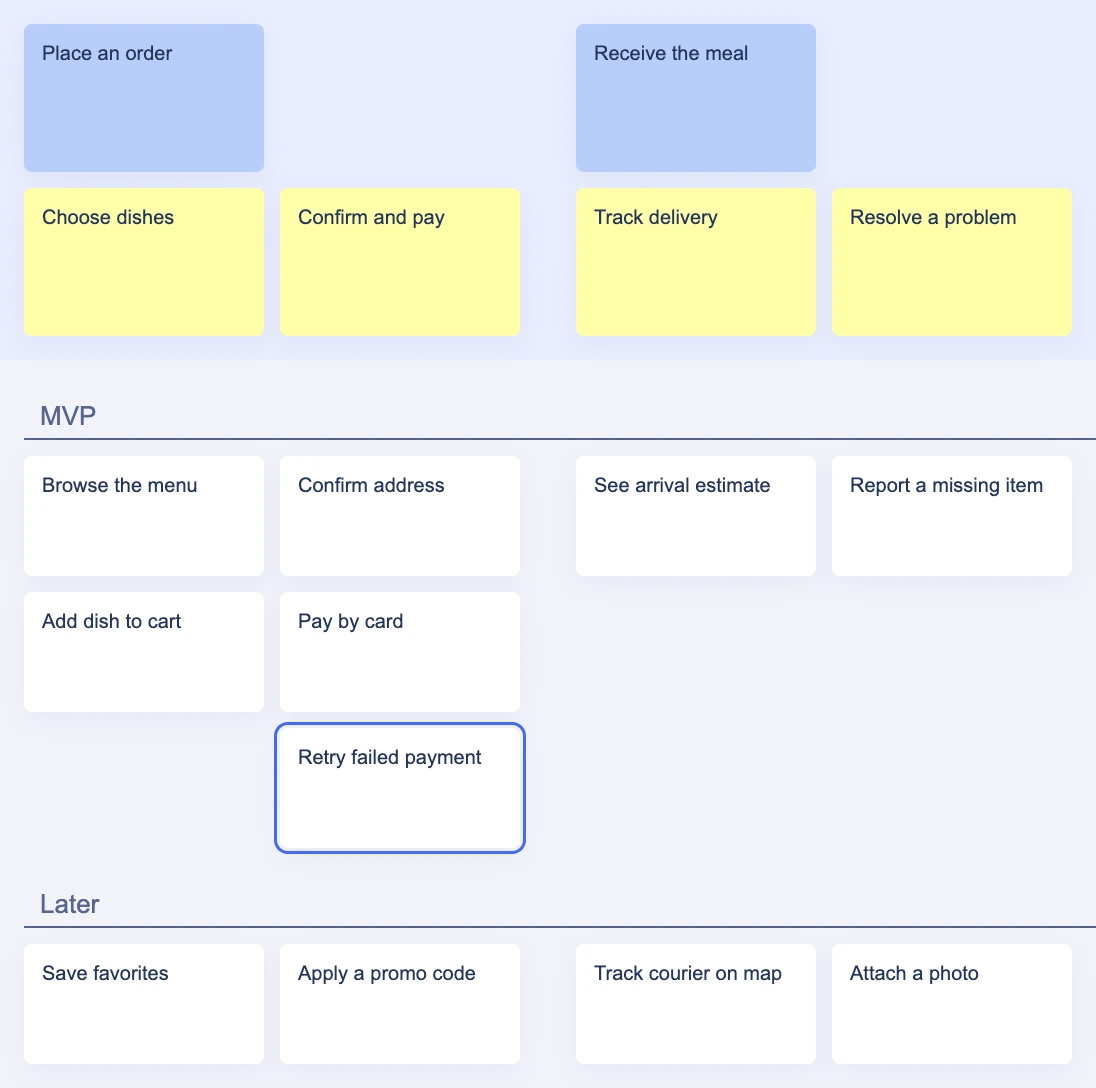
Suppose the starting request is “build a food app.” A creation task could produce hundreds of plausible cards while missing the actual problem. Begin by clarifying who orders, which delivery model applies, and what outcome the first release needs to support. Record what is outside the scope.
Once the team agrees on meal ordering for a first-time customer, move to a backbone and a proposed release. Ask for a preview of goals, steps, and stories before writing them to the board. After creation, inspect the hierarchy and check whether the release still supports the agreed outcome.
- Person
- A first-time customer ordering dinner
- Outcome
- Choose, pay, and receive a meal
- First release
- One complete ordering journey
- Open question
- What happens if payment fails?
Starting point
An open-ended request to build a food app.
More useful result
A bounded first journey: choose dishes, confirm and pay, track delivery, and resolve a problem.
Review with your team: Restaurant operations and courier management stay separate unless the team explicitly brings them into scope.
Find missing behavior, then detail the approved work
A gap review of the example might notice that payment has only a success path. Ask whether a failed payment needs a retry story, a new payment method, an order-state explanation, or a combination. The answer depends on the service's actual rules; finding a gap is not the same as choosing its solution.
After a decision, refine the selected story. Specify what remains in the cart, what the customer sees, and how another attempt begins. Keep unknown payment-provider behavior in an open question until someone verifies it. This produces a smaller, more useful handoff than fully specifying every possible future feature.
Start with one bounded task and review the handoff
Use an agent environment that supports your skill instructions and connect StoriesOnBoard MCP for board operations. Read the linked five-skill walkthrough for the workflow's intent. This page does not provide an installer or claim that a downloadable package is bundled with every host.
Begin with one map and one stage. Tell the agent what it may read, what it should propose, and when you want to review changes. At the handoff, keep the map reference, decisions, exclusions, and unanswered questions together. A new agent or a fresh conversation should be able to identify the next task without recreating the product definition.
Inspect the selected story and release.
Explain the change and open questions.
The team decides what to apply.
Read back the result on the board.
- Keep
- The selected map and release, agreed scope, relevant evidence, and decisions made during the task.
- Check
- That the result exists where expected, the next stage has enough context, and open questions have not become assumed facts.
Read the documentation: Five skills, one backlog: the workflow explained
Built with StoriesOnBoard AI + MCP
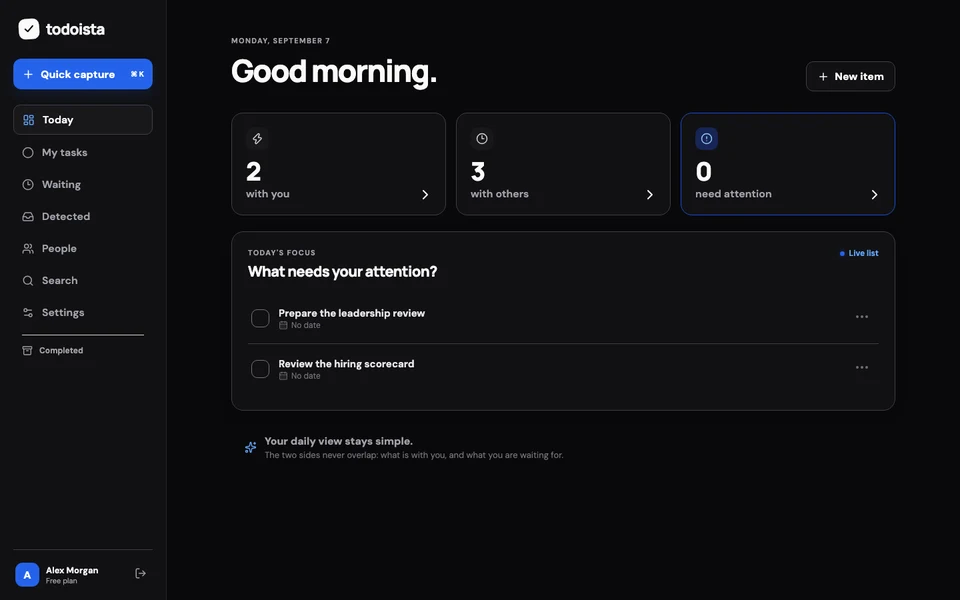
Todoista
Keep track of your tasks, delegated commitments, and the right moment to follow up.
 Explore Todoista
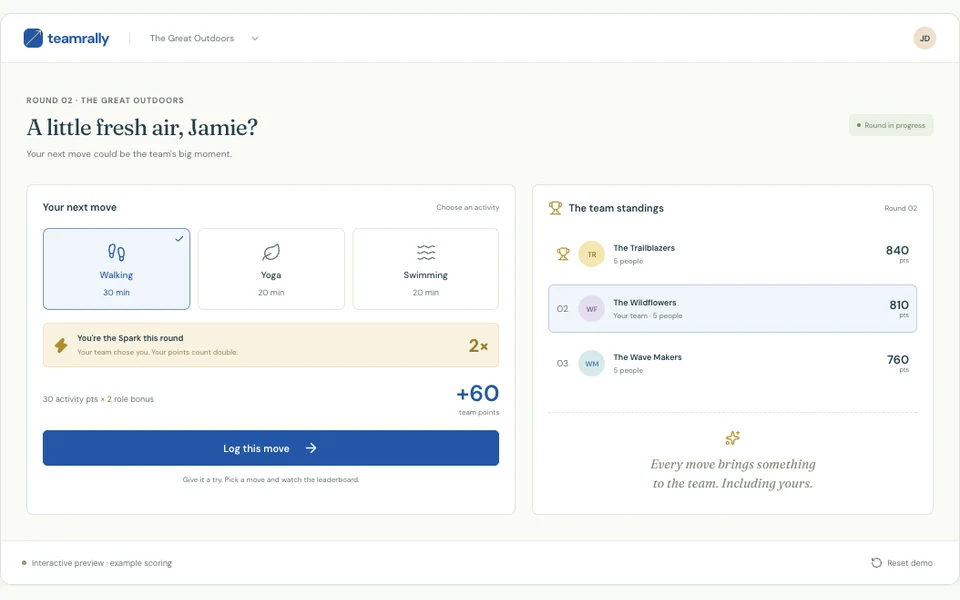
TeamRally
Explore an interactive preview of a team movement challenge, with activities, role bonuses, and shared scores.
 Explore TeamRally
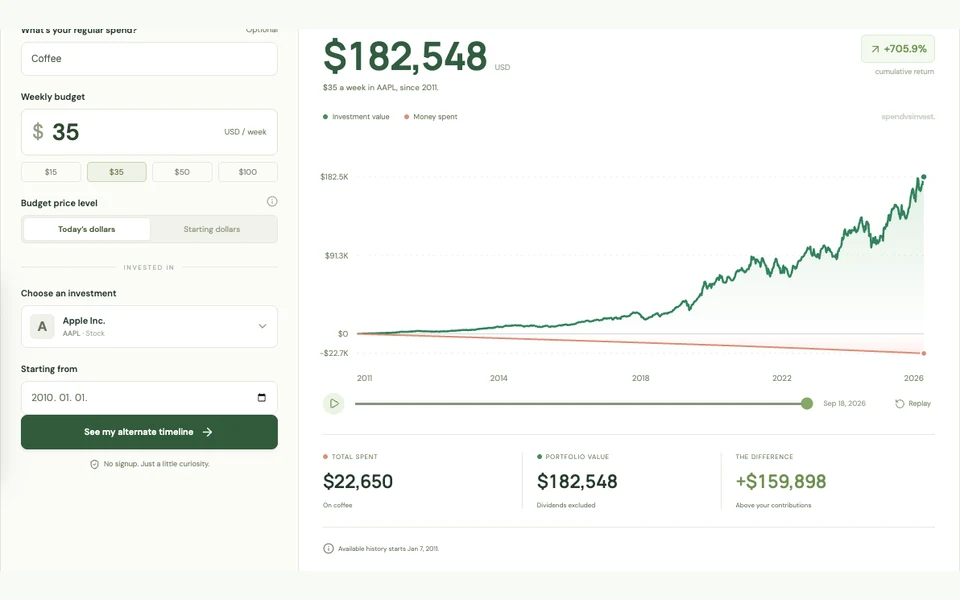
SpendVsInvest
Explore how everyday spending compares with a hypothetical investment using historical market data.
 Explore SpendVsInvest
Clear answers before you start.
Do I need to run all five skills every time?+
No. An established map may need refinement or a focused gap review rather than another discovery cycle. Choose the task that resolves the current uncertainty.
Can a skill work without MCP?+
An agent can discuss a brief without a board connection. Reading and changing the live StoriesOnBoard map requires the appropriate tools and access. Do not confuse a written proposal with a saved board change.
Where can I see the workflow in practice?+
The linked five-skill walkthrough explains the approach. The examples on this page illustrate handoffs and review questions; they are not fabricated execution logs or customer benchmarks.
Try one focused workflow on your own product.
Choose a real question, keep the scope small, and review the result with the people who own the decision.
Read the five-skill walkthrough