
Give your agent the journey behind the story.
A card title says what a piece of work is called. Its place in a story map explains who needs it, what happens before and after it, and whether it belongs in the next release. That surrounding structure gives an agent a better-defined task.
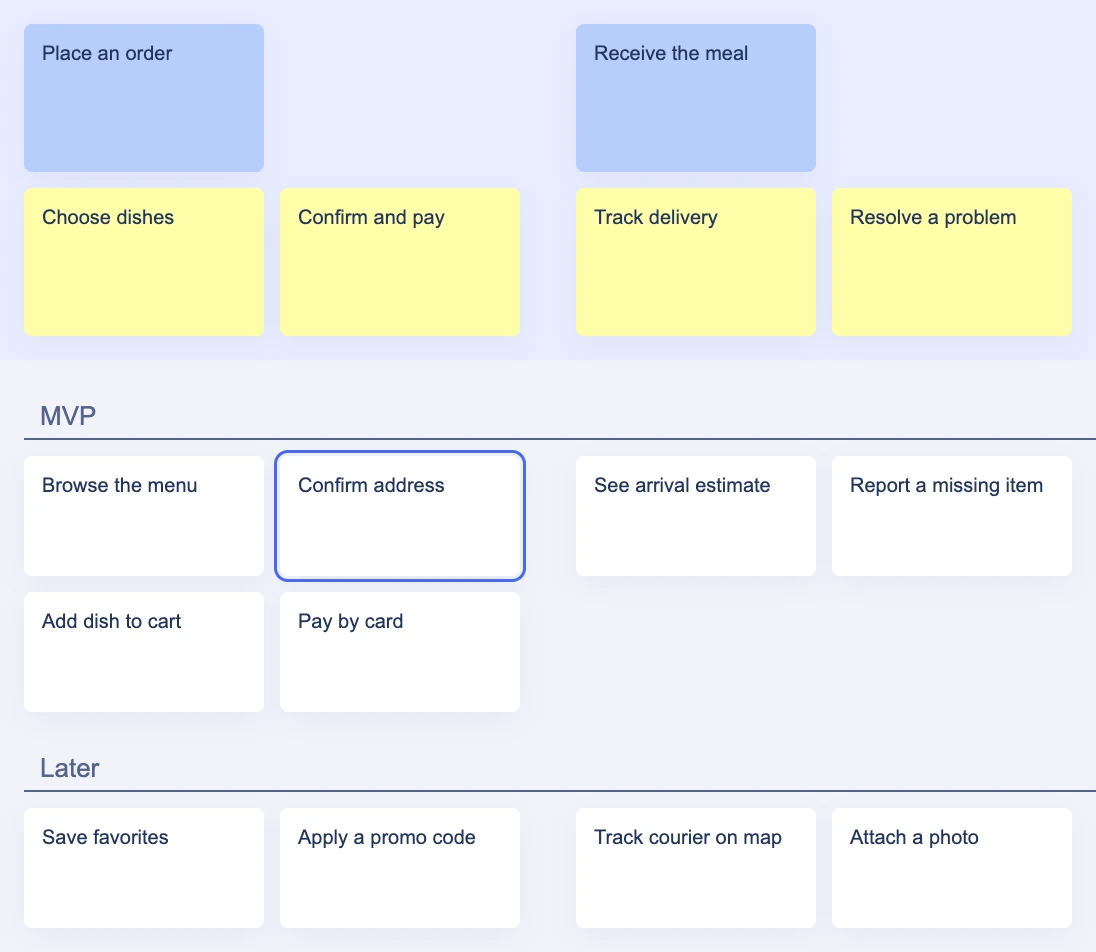
What context does a story map contribute?
A map connects levels of detail. The goal captures intent, the step gives the story a place in the journey, and the release describes the intended delivery boundary. Persona and card details add the user's perspective and the decisions that a short title cannot hold.
Context is useful when it changes a decision. Knowing that Confirm address comes before payment matters to validation timing. Knowing that it is in the first release discourages a refinement task from quietly introducing an advanced address-book feature.
Release MVP Persona First-time customer
| Context | Question it helps answer |
|---|---|
| Goal | What outcome should this work support? |
| Step and adjacent steps | What has the user already done, and what happens next? |
| Persona | Whose need and constraints are relevant? |
| Release | What is necessary now, and what is explicitly deferred? |
| Description and decisions | Which rules are agreed, and which questions remain open? |
The same request, with a better starting point
Consider the instruction “write acceptance criteria for Confirm address.” With only the title, a model might propose saved addresses, map pins, geocoding, or automatic correction. Some of those ideas could be useful, but the title provides no basis for choosing between them.
Now give the agent the meal-ordering journey, the selected MVP, and the decision that a customer can enter a delivery address without creating an account. Ask it to preserve that boundary. The example below is a planning illustration, not a measured comparison of model outputs.
Confirm address
As a customer, I want to check the delivery address before paying.
- The selected address is visible before payment.
- The customer can return to edit it.
- Editing preserves the cart contents.
To decide: required fields and delivery eligibility.
Starting point
Write acceptance criteria for Confirm address.
More useful result
Refine Confirm address for a first-time customer ordering dinner. It happens before payment. Preserve the cart when the address is edited. Saved addresses are outside this release. List unanswered validation questions separately.
Review with your team: The desired result covers the selected behavior and exposes missing rules instead of assuming account creation or adding a new address-book feature.
Retrieve the relevant slice, then inspect its details
Give an agent enough structure to understand the journey before asking it to change one card. Through MCP it can read the map hierarchy and inspect card details. For a refinement task, the target story, its parent step, adjacent stories, and release are a useful starting scope.
More context is not automatically better. A large attachment or unrelated release can distract from the task. Ask the agent to identify what it read, point to the decisions that affected its proposal, and state what it could not establish. A map is a shared source of context, not an instruction to repeat every field in every response.
Release MVP Persona First-time customer
Read the documentation: MCP capabilities and connection endpoint
Make decisions durable enough to reuse
A useful map needs maintenance. If the team agrees that address validation must happen before payment, record that decision where a future refinement task will find it. If a story moves out of the MVP, update its release placement instead of leaving a conflicting note in an old conversation.
After a change, verify both the story and its context. A correct description under the wrong step can still mislead the next reader. Assign ownership for resolving open questions and distinguish customer evidence from a working hypothesis. AI cannot make stale or contradictory information reliable merely by reading it.
Inspect the selected story and release.
Explain the change and open questions.
The team decides what to apply.
Read back the result on the board.
- Before a task
- Confirm the map, release, persona, and source of business rules. Identify conflicts rather than choosing one silently.
- After a task
- Review the updated card, its parent, and its release. Preserve the reason for a meaningful scope decision.
What a story map does not replace
The map explains product intent; it is not a substitute for source code, architecture decisions, customer research, or production telemetry. An implementation agent still needs the relevant repository and technical constraints. A discovery recommendation still needs to be tested with people who have the problem.
Treat agent-generated criteria and gap suggestions as proposals. A well-organized map helps reviewers ask more precise questions, but it does not guarantee complete coverage, correct reasoning, or a successful release. Keep the evidence behind important decisions accessible and make uncertainty visible.
- Person
- A first-time customer ordering dinner
- Outcome
- Choose, pay, and receive a meal
- First release
- One complete ordering journey
- Open question
- What happens if payment fails?
Read the documentation: Five skills, one backlog: the workflow explained
Built with StoriesOnBoard AI + MCP
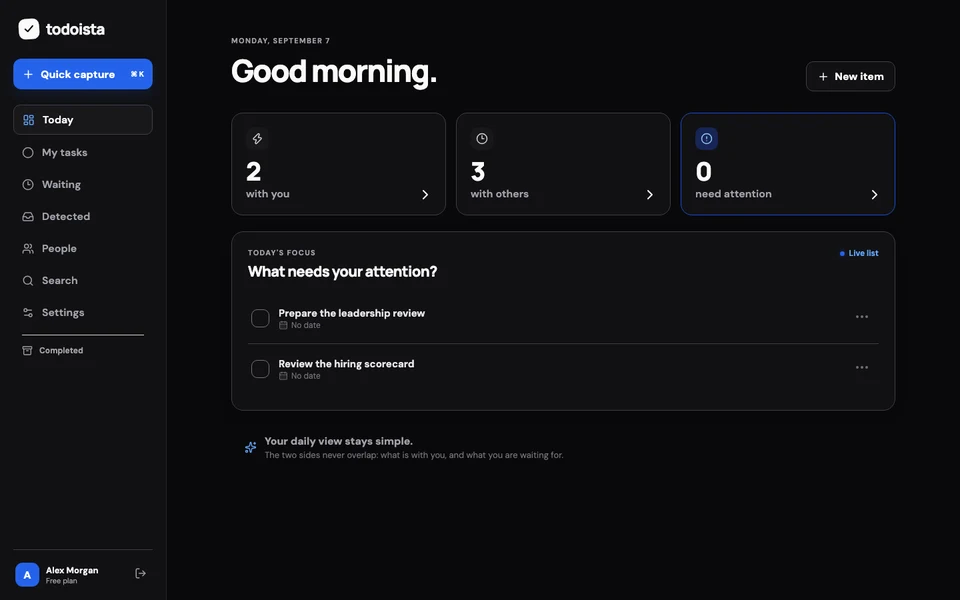
Todoista
Keep track of your tasks, delegated commitments, and the right moment to follow up.
 Explore Todoista
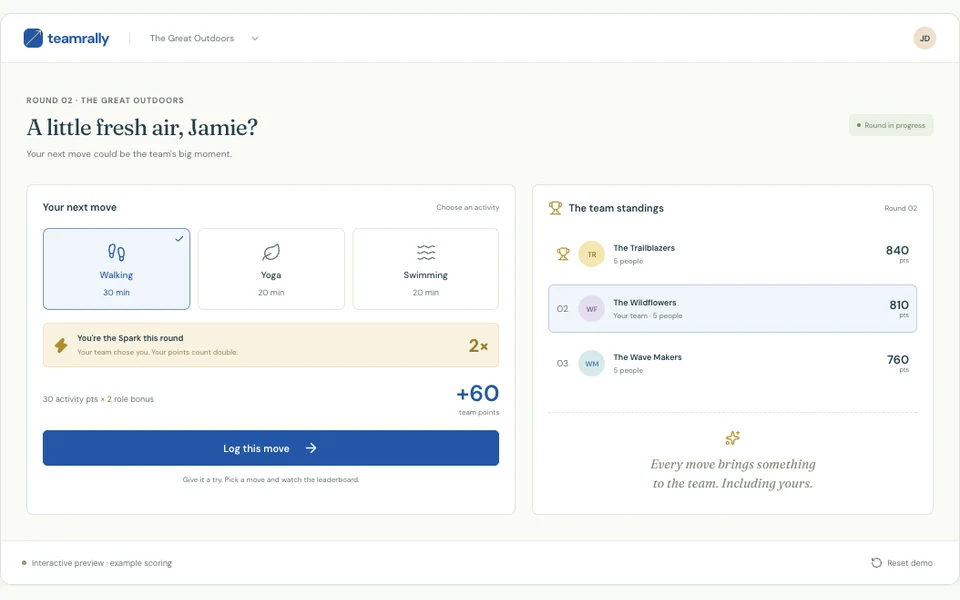
TeamRally
Explore an interactive preview of a team movement challenge, with activities, role bonuses, and shared scores.
 Explore TeamRally
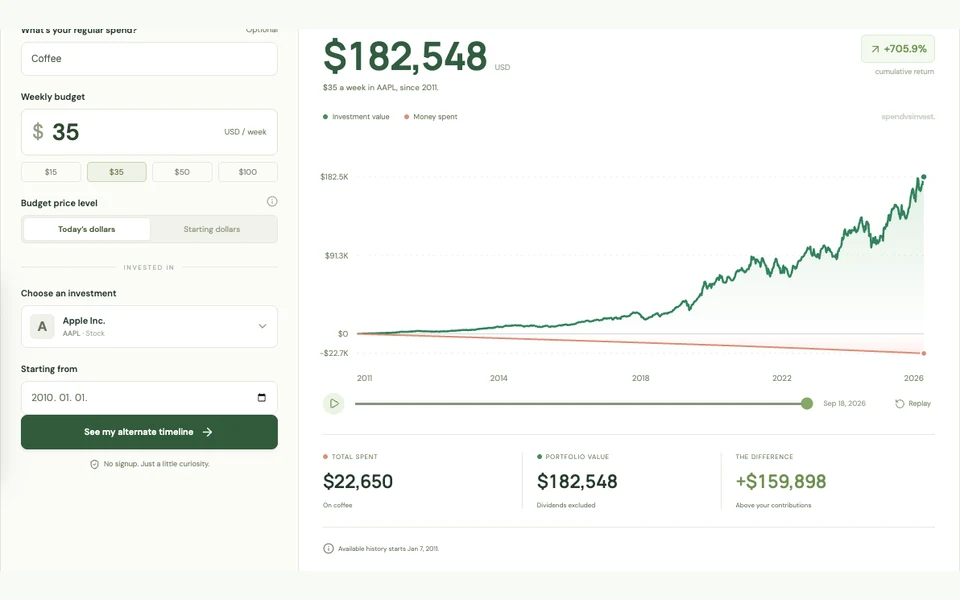
SpendVsInvest
Explore how everyday spending compares with a hypothetical investment using historical market data.
 Explore SpendVsInvest
Clear answers before you start.
Is product context just the description of the product?+
The description is a starting point. Useful task context also includes the user, journey position, release boundary, related stories, and recorded decisions. Different tasks need different subsets of that information.
Will connecting MCP make an agent read everything automatically?+
The connection exposes tools; the agent workflow determines what is read and why. Specify the target map and task, and ask the agent to explain the scope it inspected.
Can a flat backlog still be useful?+
Yes, especially for tracking individual work items. A story map adds an explicit journey and release view so teams and agents can reason about the relationship between those items.
Try one focused workflow on your own product.
Choose a real question, keep the scope small, and review the result with the people who own the decision.
See how MCP reads the map